Online crash gaming usually provides quick hits of adrenaline, all about fast moves and instant payoffs https://bigbasscrashcasino.ca/. But a recent story changed that. A Canadian player pulled off something many believed was impossible: an incredibly long sequence of wins in Pragmatic Play’s Big Bass Crash. We lack the player’s name or their exact winnings, but the core point of a long string of successful cash-outs has the gaming world discussing. This wasn’t just a lucky hour. It suggests someone who grasps the game’s engine, handles risk with discipline, and holds a level head when most people would break. For anyone keen on crash games, from casual players to hardcore analysts, this event forces you to pause and think about what it really takes to succeed.
Understanding the Big Bass Crash Game System
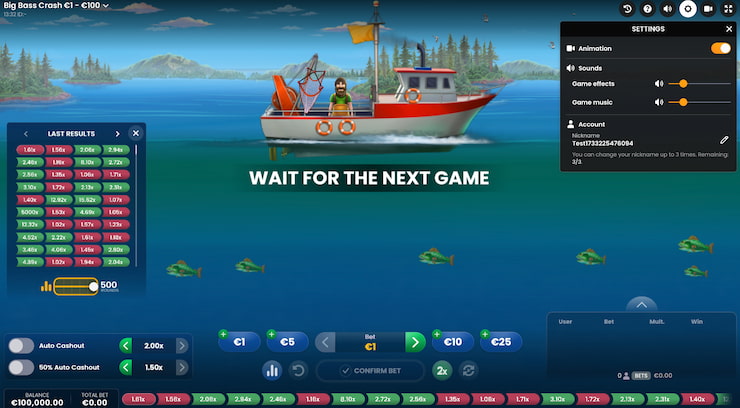
To understand why a extended winning streak is such a major deal, you need to know how Big Bass Crash functions. It’s a crash game. You put a bet, and a multiplier commences climbing from 1x, moving up along a curve on your screen. Your sole job is to cash out before that multiplier crashes. The crash happens at a random, hidden moment, set by a provably fair algorithm. Cash out in time, and your bet gets increased by the number you secured. If the crash hits first, you miss that bet. Big Bass Crash combines this simple idea in a fishing theme from the popular Big Bass Bonanza slots. You’ll see fishing rods, tackle boxes, and that animated fisherman. As the multiplier increases, special symbols can pop up, awarding out instant cash prizes or collecting lures that result to a free round. This introduces another layer to the waiting game past the basic cash-out choice.
The Function of Random Number Generators and Provable Fairness

Every aspect in Big Bass Crash is based on a Random Number Generator (RNG). Independent testers validate this RNG to make sure every crash point is entirely unpredictable and unpredictable. The system is provably fair. In theory, players can check the result of any round to confirm it was legitimate. This transparency counts. It shuts down any idea that the game is manipulated or that bets or past rounds affect the crash. Each round exists separately. In this environment, a winning streak is not proof someone outsmarted the machine. It means they made sound decisions against a backdrop of pure chance. The RNG keeps the crash moment arbitrary, so all the pressure falls on the player’s timing, their plan, and their nerves.
The Payout Timing: Psychology of Timing
In Big Bass Crash, the sole action that counts is cashing out. There are no paylines or symbol combos to decipher. Just one button. That basic decision creates a massive psychological tug-of-war. As the number gets higher, greed clashes with fear. Exiting early at a low multiplier secures a small, safe profit. But if the multiplier keeps climbing afterward, it feels like you missed out on money. Holding out for a bigger number enhances your potential win, but it also heightens the chance you’ll get nothing when the game fails without warning. The game becomes a straightforward test of your personal risk tolerance. A long winning streak tells us the player conquered this internal battle. They established a consistent, disciplined method for when to cash out, prioritizing steady gains instead of seeking one enormous, risky payout.
Calculated Approaches Driving Sustained Success
Keeping a win streak active in a luck-based game requires a system that mitigates the blow of randomness. The Canadian player’s approach, tailored to their playstyle, presumably rested on a handful of common strategic pillars. The first and most important is bankroll management. This entails defining a strict budget for your session and setting your bet size as a small, predetermined percentage of that total. By never risking a big part of their bankroll on a single round, the player made sure a unexpected crash wouldn’t clean them out. This protected the funds required to keep playing and applying their strategy over numerous rounds. The next pillar is choosing your cash-out points beforehand. Able players often choose their desired multiplier prior to the round even starts. This removes the subjectivity out of the call when the figures are racing. The objective could be a fixed value, like 2x, or a flexible one based on how past rounds have behaved.
Another possible strategic aspect includes monitoring patterns, with a giant warning label included. Every round is independent, but some players monitor short-term trends in crash points. They aren’t trying to predict the unknown. They’re seeking to gauge the current volatility of the game. For example, a run of a few very quick crashes may push a player to cash out a bit faster on the following round. The secret is to utilize these observations as subtle hints within a firm strategy, not as strong signals. Lastly, leveraging the game’s bonus features tactically is critical. Striving to accumulate lures for the free round feature offers you a additional objective. It offers benefit outside the regular crash round, providing guaranteed rewards and a further way to make a profit. A disciplined player would incorporate these bonus rounds into their complete session plan.
Anatomy of the Historic Streak
The Canadian player’s claimed streak was a confirmed sequence of consecutive winning rounds across several sessions. The exact number of wins is private, but sources say it was far outside normal statistics. The streak probably mixed low and high multiplier cash-outs. That hints at a strategy that was both flexible and tough. It’s unlikely the player kept shooting for enormous multipliers every time. Statistically, that approach would fail quickly. A more plausible analysis shows a model built on collecting lots of smaller, reliable wins, then occasionally taking the multiplier higher when the moment felt right. This reflects a principle from financial trading: consistent, modest gains often build more reliable profit over time than pursuing a few risky jackpots. The length of the streak suggests the player followed this rule without fail, avoiding the common trap of recovering losses or changing their whole plan after a couple of good rounds.
Validation and Community Verification
These days, a major gaming feat rarely stays secret. The Canadian player’s streak found its way into dedicated online gaming communities and forums. There, other players put it under the microscope. They studied shared screenshots, video clips, and platform data to check the wins were real and consistent. This kind of crowd-sourced verification is now a standard part of gaming culture. It turns big claims into trusted facts. The game’s provably fair system also let people do a basic audit of the round history. This verification process gives the achievement weight. It moved the story from rumor to a documented milestone for the Big Bass Crash community, creating a real target for others to strive toward.
Repercussions for the Wider Crash Gaming Scene
The verified long winning streak in Big Bass Crash impacted the international crash gaming scene. For one, it explained the genre. It showed that while each round’s outcome is random, a player’s discipline and strategy can determine their results over a session. It changed how people see crash games. They’re not just pure, uncontrollable gambling. They’re an arena where skill understood as risk management and emotional control can appear as real, measurable success. This ignited deeper analytical talk. Community forums now feature more detailed strategy guides and psychology tips, not just screenshots of big wins. The achievement established a new high bar to strive for.
It also highlighted the importance of choosing your game and understanding its features. Big Bass Crash, with its bonus lure collection and free rounds, offers more strategic depth than a basic no-frills crash game. The streak illustrated how using these extra features can increase your overall profitability and help a session last longer. As a result, players are getting more selective. They’re evaluating crash games not just on how high the multiplier can go, but on the tools they offer for thoughtful, strategic play. This event pushes the genre toward a more mature, analytical approach, building a community that shares insights on how to play sustainably.
The Psychological Resilience Demanded
More than any calculations or tactics, the mental game is where long winning streaks are made and destroyed. The Canadian player demonstrated serious emotional discipline. Maintaining a streak demands a stoic commitment to your own rules, regardless of what just occurred. It means acknowledging that losses are inherent in the game’s randomness, and not letting them make you abandon your plan. It also means handling the high of success. A series of wins can create a feeling of invincibility that causes reckless, high-risk bets. The mental challenge is about consistency, patience, and detaching from the emotional rollercoaster to aim for a longer-term goal.
Dealing with Variance and Near-Misses
A real test of mental strength is how you manage variance and near-misses. Variance is just statistical noise. It can mean encountering more crashes in a short period than the averages would suggest. A resilient player recognizes this and doesn’t discard a solid strategy during a short downswing. Near-misses are more torturous. Imagine withdrawing a split-second before the multiplier jumps to 100x. Or crashing just after you decided to wait one more moment. These moments can mess with your head. They create stories of “almost” that make you question everything about your approach. The skill is to view each round as its own event, to count any win as a success no matter the size, and to dismiss all the “what if” thoughts. The record streak implies this player had that clinical level of detachment.

Mixing Inspiration with Controlled Gaming Realities
The Canadian player’s story is a intriguing look at strategy and mindset. But we have to balance that inspiration with the basic facts of responsible gaming. A long winning streak, no matter how remarkable, is a statistical outlier. The core mechanics of Big Bass Crash, like all crash games, are built on a negative expected value over time. This is governed by the game’s return-to-player (RTP) percentage. The RNG guarantees no strategy can erase the house edge in the long run. So, this story shouldn’t be seen as a template for guaranteed profit. It’s an extraordinary example of maximizing success within a limited window. It reminds us that the main goal for any player should be enjoyment. Any money spent is the price of that session.
Knowing the difference between session strategy and long-term expectation is crucial. A player can expertly manage a bankroll and keep their cool to get the best possible result during a single gaming session. That can lead to a positive outcome for that session, as the streak proved. But over thousands of sessions, the mathematical edge of the game always prevails. Therefore, the lessons here are about extending your enjoyment, managing your risk, and keeping control while you play a game for fun. They are not about finding a secret “winning system.” Celebrating the skill in such a streak must always come with clear reminders about the game’s random nature and the importance of playing within your limits, just for fun.
A Fresh Standard in Strategic Gameplay
The most extended winning streak in Big Bass Crash, achieved by a player from Canada, is a benchmark in online crash gaming. It reveals that inside a world of randomness, human decision-making and discipline can create remarkable stories of sustained success. The streak wasn’t a lucky accident. It was a verified win founded on careful bankroll management, a pre-set plan, and, possibly above all, serious psychological toughness. It has deepened the community’s understanding of crash games, fostering a more analytical and measured way to play. This achievement reshapes what skill means in a crash game. Skill isn’t about predicting the unpredictable. It’s about governing your own actions and reactions while you confront it. The inherent randomness and house edge in Big Bass Crash haven’t changed. But this story will persist as a compelling example for players who want to navigate its thrilling, volatile waves with more purpose and control.